

How Beginners Should Train for Muscle and Strength (A Simple Program)
Beginner Training Program

What “Beginner” Really Means in Strength Training
I categorize trainees into 3 buckets: beginner, intermediate, and advanced.
Training age is important but not the only factor in determining someones level. Keep in mind, being a “beginner” isn’t bad. It’s possible to train for 5+ years and still be a beginner. Everyone defines beginner differently, so here’s my definition.
You’re a beginner still if…
You never did a serious strength training program with programmed progressions (or done one for less than 1 year)
You train 2x a week or less
You only use machines
You haven’t plateaued in your training and found a way to break through
Usually people stall and just never get better
The Biggest Mistakes Beginners Make When Training for Muscle Gain
Intensity is too low
There are no logical & systematic progressions in your plan
Inconsistency
i.e., you tell people you workout 4x a week but on average it’s 6 or less a month in reality.
Not eating enough
If you’re not seeing results or have plateaued for over 4 weeks as a beginner, you need to fix atleast one of the points above.
I wrote a more extensive article on this topic that you can find with the link below.
How Many Days Per Week Should Beginners Lift Weights?
2 is fine, 3 is good, and 4 is where the magic happens. You will always be a beginner if you only train twice a week. Again, that’s fine, no shade. Just realize there’s no reason then to use more advanced techniques like extended sets, bands, chains, isometrics, etc. They’ll be novel, but likely provide little benefit compared to what they would for an advanced trainee.
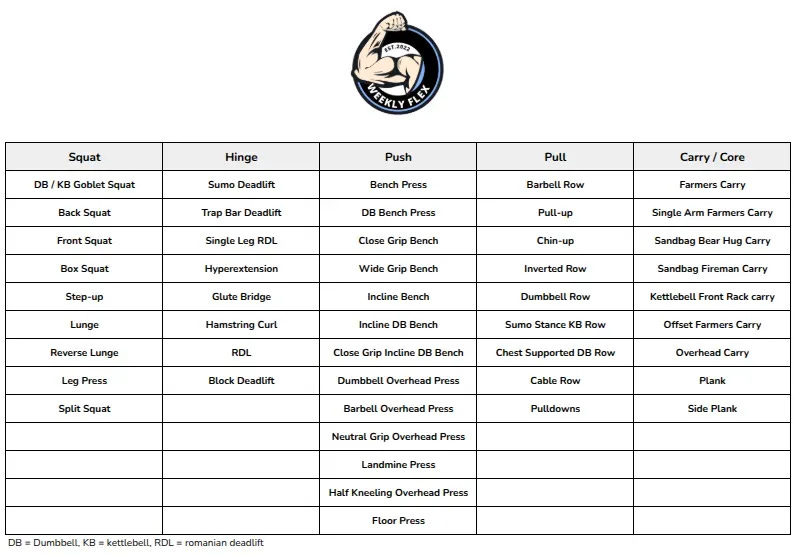
We want to hit each movement pattern twice a a week ideally.
Movement Patterns = Press, Pull, Hinge, Squat
Primary Muscles Groups
Each movement patterns hits a series of primary Muscles Groups. Other muscle groups may be slightly active still, it really depends on the movement but grouping by movement patterns is better than by muscle group from my experience.
Presses: chest, shoulders, and triceps
Pulls: back and biceps
Hinges: glutes and hamstrings
Squats: quads
The Best Rep Ranges for Beginners to Build Muscle and Strength
Generally speaking 6 to 12 reps works best. Aim closer to 6 if you want more strength gains and closer to 12 if you care less about strength and more about muscle. This conversation can get pretty nuanced, generally speaking higher reps lead to better hypertrophy (muscle gain) long term.
You can still gain muscle training with 6 reps or less, however as a beginner you’re less efficient. You can’t recruit the same amount of muscle fibers as an advanced trainee, you’ll benefit more from higher reps due to nervous system inefficiency (you’re not skilled at the movement) and inability to recruit a high level of motor units.
6 to 8 reps is a good range for training a hybrid of strength and size but i’d atleast do a few months around 10 to 12 reps before going there.
Rep Ranges I recommend:
3-4 sets of 6 to 10 reps
or
3-4 x 8 to 12 reps
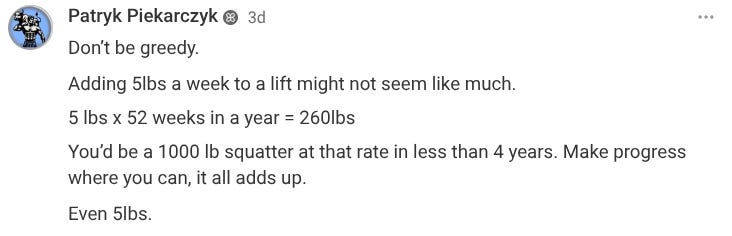
The best way is to pick one of these 2 rep ranges and at first just hit them for every single exercise. Try to add reps each week. If you can hit the top of the rep range (9-10 reps each for 6-10 rep range for example), then add weight.
Add as little weight as possible. You don’t need to add a lot of weight to make progress, don’t get greedy.
I wrote a more in-depth article on this as well that you can read below.
Full Body or Split Routines
Full Body (FB) training recently became cool again. The alternative is a split routine where you either alternate between upper and lower, or something like a chest day, arm day, etc.
One of the most beneficial aspects of FB is the fact that you get repeated exposure to a stimulus. Training chest once a week means you train chest 4 times a month (provided you never skip a session).
Full Body training allows you to do 2-3x more work. You can stimulate without having to annihilate. Beyond a certain point just doing more volume isn’t going to be beneficial. If the muscles gone through significant strain & mechanical tension, then the growth stimulus has been achieved and adding more is simply just going to yield diminishing returns on your effort.

Full body also allows you to train the same movements more often which makes it easier to progress in weight since you’re not changing exercises often, and allows you to build skill (technique) rapidly.
I’m a fan of full body for beginners especially if they aren’t going to religiously be in the gym. If I expect clients to miss a day or two every couple of weeks i’d rather them do a 2-3 x a week full body training than have to miss a day on a split routine and then basically leave that muscle un trained for up to 13 days.
You also won’t be as intensely sore doing 3 to 6 sets of a muscle group twice a week as you would be doing 12 sets of a muscle group once a week. Better recovery usually is going to result in better gains.
That being said, if volume is equated (amount of sets and reps) then research doesn’t show much difference between full body and split training. Pick the split that you can consistently commit to.
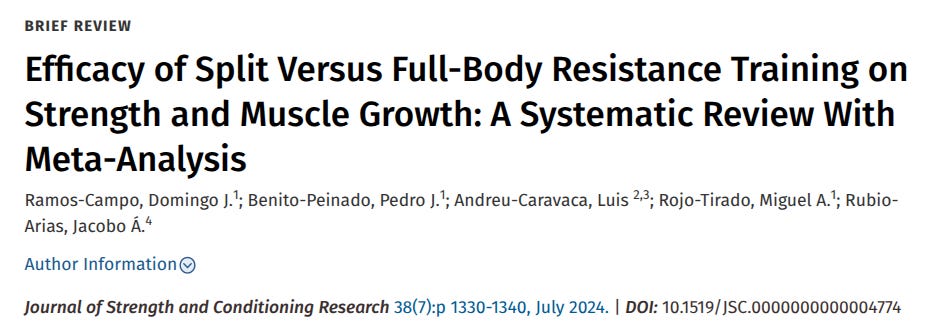
“Meta-analytic analysis of hypertrophy variables revealed that both training modalities (split vs. full-body) similarly increase muscle size. This implies that based on the current scientific evidence, the distribution of training volume throughout the week does not play a significant role in improving muscle mass. Remarkably, the muscle growth observed in the studies included in this review aligns with previous research findings (3).”
Simple Beginner Training Splits That Actually Work
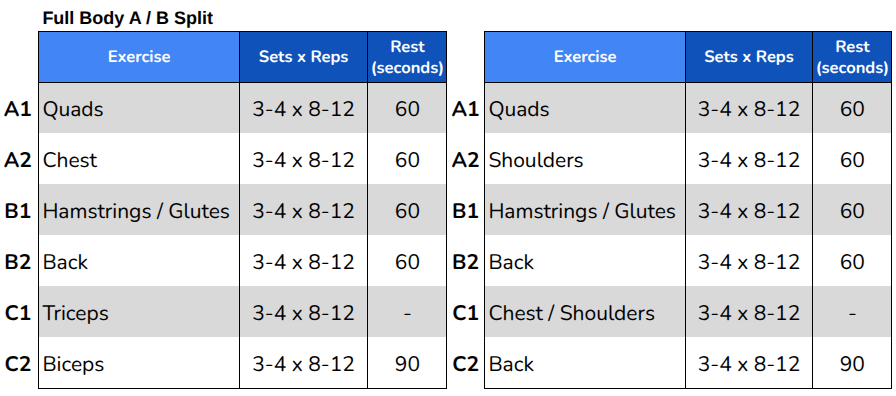
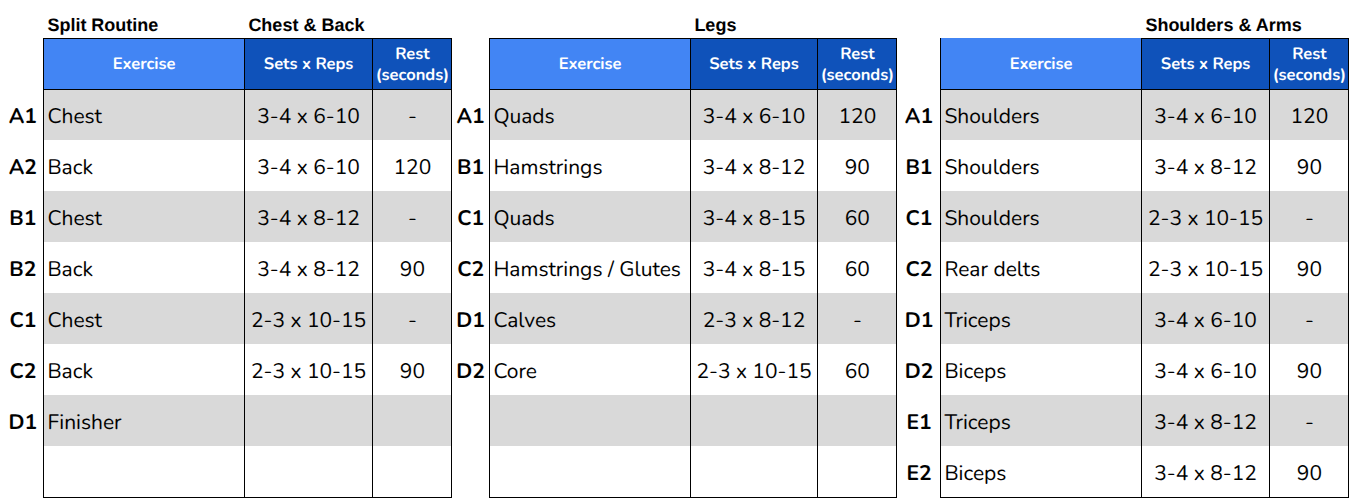
There are 3 primary training splits I’d recommend. A body part split, A/B Full body, or A/B/C full Body. If you only train twice a per week, i’d recommend training 3 to 4. If you still think you can only train twice a per week, then just do full body A/B for best results.
If you train 3-4x a week any of these splits will work decently well provided you train hard, progressively, and consistently. You can simply rotate templates to fit your split. The A/B split can be done over 3 days and the body part split can be rotated over 4 days as well.
Full Body A / B Split
Body Part Split
Full Body A / B / C Split
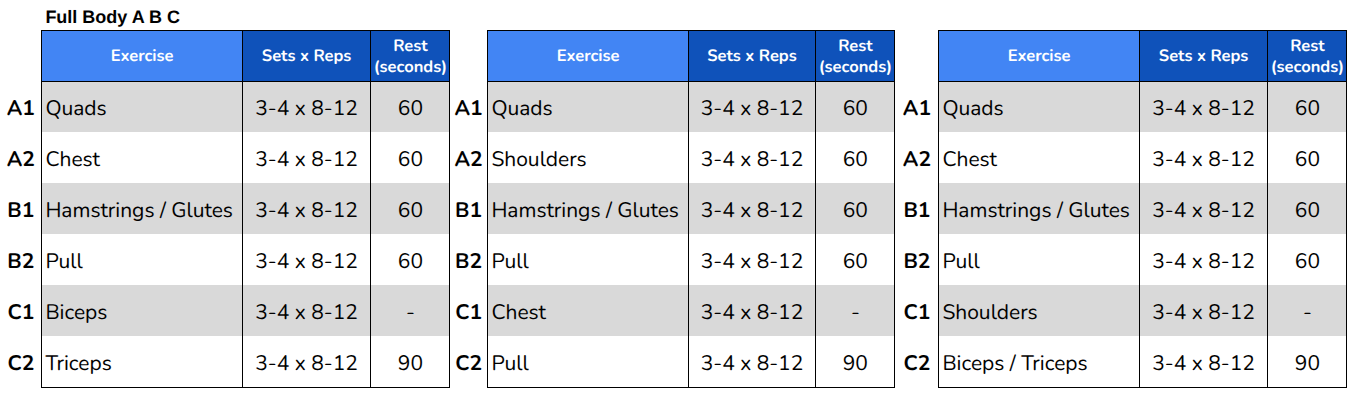
Seems simple, because it should be. The basics are the basics because they work. You can’t sell “the basics” in a $1000 course. Don’t skip the fundamental phase of training before moving to more advanced methods.
When a Beginner Should Move to an Intermediate Program
There’s no rush, ride out a linear Progressions and add reps or weight weekly as long as possible. If you feel progress stalling and have been on the plan for 6+ months, it’s likely time to make a change.
Once that occurs, you’ll likely need to do slightly more volume and other training splits, like Upper Lower, may be more conducive to your goals.
Training Progressions
How you progress your training matters if you want to see real results. I’m a big fan of microloading (adding 1-2lbs a week to a movement) or adding reps at first. Eventually, performing dedicated phases of strength, hypertrophy, or other qualities will become important to build a well rounded program.
Use the progressions below to essentially make progress forever, or until you hit the dirt.
